
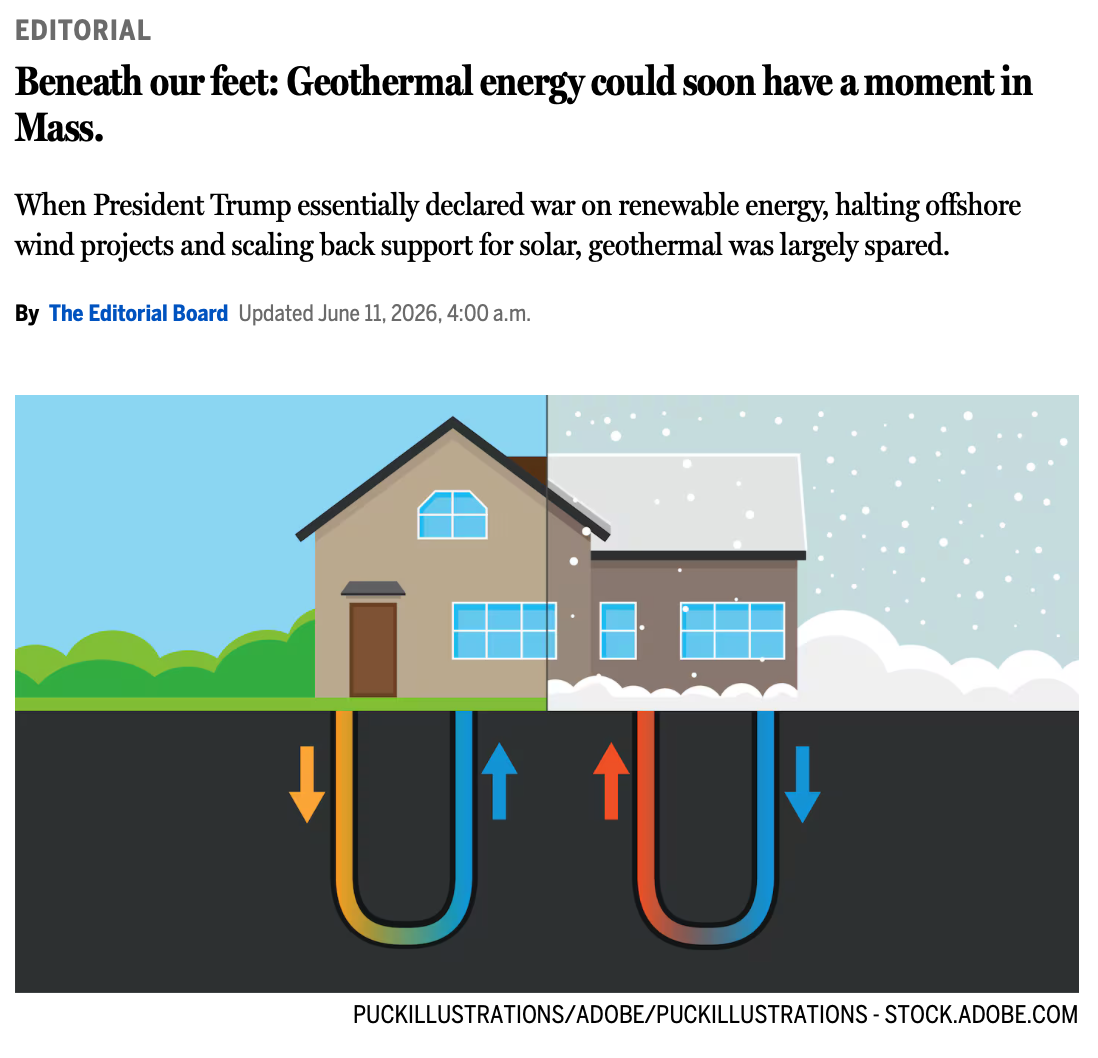
In its June 11th issue, the Editorial Board of The Boston Globe calls for concerted attention to the “clean, limitless energy source right beneath our feet that could lower utility bills and fight climate change.” Geothermal’s time has come. One challenge is how to make the numbers work; another is designing solutions that fit the unique needs of older buildings.
The editorial applauds Governor Maura Healey’s proposed legislation that encourages geothermal energy to heat and cool building, “which now account for about 30 percent of greenhouse gas emissions statewide.”
On the national level, the Board writes, “geothermal seems to be having a moment. When President Trump essentially declared war on renewable energy, halting offshore wind projects and scaling back support for solar, geothermal was largely spared. It helps that the industry has a lot of overlap with the oil and gas industry, sharing drilling equipment, workers, and investors…
Geothermal engineering designs can be quite complex, and one size does not fit all as challenges vary from project to project. But technologies continue to improve and knowledge of best practices advances with each blueprint.
Similar to nuclear energy, geothermal is relatively inexpensive per unit of energy produced once a system is operational. The biggest barrier to entry, however, remains upfront costs…
To help overcome upfront costs, the governor and House are proposing legislation to allow gas companies to own the heat loops beneath large buildings at places like universities and hospitals, which is not currently permitted. If a building owner agrees to a partnership, the gas company could recoup costs through tariffs — rate structures, fees, and rules — designed for that specific customer. Utility customers who aren’t part of the geothermal project would not pay for it, but its existence could lower energy bills for nearby homeowners and renters, as large buildings converting to geothermal would decrease overall energy demands.
The other challenge with any geothermal conversion lays within old buildings themselves. BU’s Jenga Building was a blank slate. But many of New England’s buildings are still warmed by steam heat delivered through old clunky radiators, a 19th-century technology. Ripping cast iron radiators out and replacing them with heat pumps and duct work would be cost prohibitive for many projects…”
Read the full editorial.