
By José C. Massó III and James Michel, members of the Crane Ledge Woods Coalition
This Opinion appears in the March 4th issue of The Boston Globe.
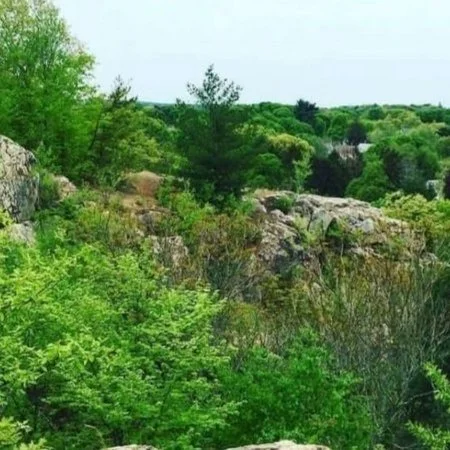
On the border of Hyde Park, Mattapan, and Roslindale lies a 24-acre sanctuary, something increasingly rare in Boston: wild, urban woodland. Crane Ledge Woods — with its sweeping tree canopy, stunning vistas, climate benefits, and surprising biodiversity — is the city’s largest remaining unprotected urban wild. A 204-unit housing development has been proposed for a portion of this natural land.
There is, of course, a need for more housing in the state, and Boston must continue to do its part.
Protection of natural places is not a default “no” to all housing. The Crane Ledge Woods Coalition has endorsed Boston Mayor Michelle Wu’s Squares + Streets initiative to support housing, public space, small business, and culture, for example.
The community-based Squares + Streets approach would allow the development of an estimated 1,000 new units in the heart of Hyde Park, directing density to sites near transit and walkable business districts. While mindful of the serious risk of displacement of residents, this streamlines development approval where housing is best located, through new construction, adaptive reuse of historic buildings, and reinvestment in our city’s neighborhoods.
In contrast, the housing proposed at Crane Ledge Woods would require clear-cutting 14 acres of tree canopy, destroying a vital carbon-sequestering cooling zone and wildlife refuge, to build a car-centric, gated heat island. This is not a model of sustainable or equitable development for Boston or the Commonwealth.
Protecting woodlands like Crane Ledge while increasing housing density near transit and walkable main streets are necessary complements. Our woodlands provide measurable public benefits for residents: They sequester carbon, absorb water and protect against flooding, cool neighborhoods during increasingly dangerous heat waves, filter air pollution, buffer sound, and provide a home for wildlife and spaces for all to enjoy.
At a time when local action to address climate change is an undeniable imperative, development decisions must withstand stringent scrutiny when irreplaceable natural resources are at stake.
The Crane Ledge Woods Coalition was formed in 2021 and now includes more than 50 organizations citywide, from City Life/Vida Urbana to the Boston Building Trades Council. Through an open, inclusive process respectful of all views, we have developed an alternative vision: The city should purchase the land for permanent conservation, with owner Jubilee Christian Church and its development partner compensated fairly.
Climate action plans adopted by Wu and Governor Maura Healey identify preserving woodlands as among the most cost-effective strategies to address climate change and advance environmental justice. As elected officials pursue ambitious targets, destroying 14 acres of woodland in our own backyard seems at odds with our stated values.
Boston has a tradition of far-sighted civic vision, from the Emerald Necklace and the “People Before Highways” movement to the Rose Kennedy Greenway and Neponset River Bike Path. In building these spaces, elected officials working together with residents set aside conventional thinking and recommitted themselves to sustaining the commons.
Crane Ledge Woods presents another once-in-a-generation opportunity. With legal hurdles resolved and the Boston Planning and Development Agency board’s reluctant approval last September allowing for an accurate appraisal of the value of the land, which should be undertaken as soon as possible, achieving conservation of Crane Ledge Woods is within reach.
For a public benefit purchase, the city is bound by appraised value. While each property is different, and the first step is an on-site no-obligation appraisal, recent city parkland acquisitions have been in the $12 per square foot range, which for the 24-acre Crane Ledge Woods would be $12.7 million, or 0.5 percent of the city’s annual capital budget. For context, Boston’s $4.2 billion capital budget has 433 individual project line items.
As an inland green infrastructure project with many additional public benefits, a Crane Ledge Woods acquisition would fall in the low-to-middle range of the city’s climate-focused capital projects. Wu is now uniquely positioned to deliver a widely supported acquisition of Crane Ledge. Mass Audubon, the state’s leading conservation organization, has developed a concept plan for these woods. Through its capital budget, the city has the means to achieve this goal.
An inspiring civic vision is not the exclusive property of our predecessors. Our hope is for a Boston that leads the way: building equitably while protecting our natural spaces. In a city where nearly every parcel faces development pressure, preserving our last wild places is an investment in our collective well-being, our environmental resilience, and our connection to the natural world that sustains us all.
Photo: Crane Ledge Woods Coalition