
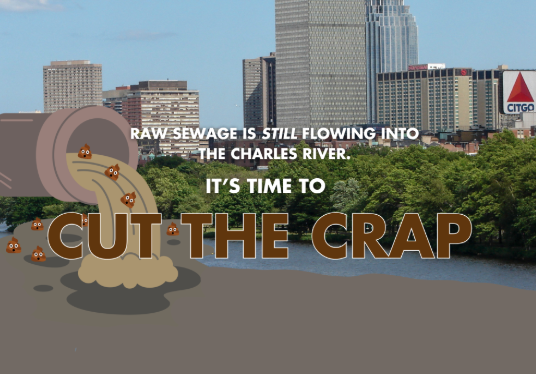
A long-awaited report by the Massachusetts Water Resources Authority (WMRA) posits that the Charles River is fated to be a sewage dumping ground forever. Emily Norton, Executive Director of the Charles River Watershed Association, responded to the October 29th report by emphasizing that “no amount of sewage is acceptable in the Charles.”
In her letter to the MWRA, Norton established these priority points:
“The Charles River is Not a Sewer
MWRA is using the Charles River as sewer conveyance. The Charles River is Not a Sewer MWRA is using the Charles River as sewer conveyance and treatment infrastructure due to inadequacies in the current sewer network and treatment system. This is illegal, disgusting and not befitting of modern, world class cities such as Boston and Cambridge, nor is it befitting of a trusted, well-respected water resources authority like MWRA.
The Charles River is Neither a “Lost Cause” nor a Dump
Throughout Boston’s development, many past leaders dismissed the Charles River as a ‘lost cause,’ a water body so dirty it was not worth saving. Historically, each of these individuals was proven wrong as the Charles River has gone through multiple renaissances: from better management of solid and industrial waste to illicit connection consent degrees to the first Long Term Control Plan, and more recently better stormwater management requirements. Despite this lesson from the past, we unfortunately hear MWRA staff voicing the same sentiment today, that the Charles is so dirty, we may as well dump untreated sewage into the lower portion of the river—the implication being that this will only impact the Environmental Justice communities along the lower Charles, and not disturb the wealthier, upstream communities. This argument also fails to acknowledge the difference between stormwater pollution and sewage pollution as well as the requirements already in place to address stormwater pollution via the Massachusetts Small Separated Sewer System permit.
Discounting Benefits.
No initiative was taken to explore the use of green stormwater infrastructure and nature-based systems. We repeatedly heard MWRA discount these proven and cost-effective techniques. This is a serious failure, and a disservice to MWRA customers. To properly address CSOs, one must deal with stormwater, and to their credit the cities of Cambridge and Somerville have demonstrated a willingness to do so. As the Board of this trusted Authority it is incumbent on you to not be the reason our region cannot benefit from these types of innovative solutions, but rather to demand that MWRA staff take a comprehensive and modern approach to addressing the CSO problem in the most cost effective manner possible, including removing any barriers to pursuing green infrastructure solutions. Modern wastewater treatment agencies acknowledge and champion the multiple co-benefits achieved with such an approach, including improved adaptation to climate change by reducing flooding and heat impacts, in addition to reducing or eliminating CSOs. Not considering all solutions will result in projects that are more expensive and less effective and beneficial to the residents, visitors, and economy of the Commonwealth.
Lack of Consensus and Lack of Support
We strongly oppose the ‘preferred alternative’ put forth for the Charles River. By our review, the scope of work set by EPA and MassDEP implies that the process to this point should have led to consensus on a preferred alternative. This is absolutely not the case. Alternatives were only made public within weeks of a “preferred alternative” being selected. By the time alternatives were made public there was no time left for the team to take feedback on the individual alternatives or take suggestions from the public on new alternatives, for example alternatives that could combine some elements of one alternative with elements of another.
Inadequate Level of Control
We strongly object to the selection of a ‘preferred alternative’ at the lowest possible level of control from all the alternatives selected. This is not a serious suggestion and needs to be rejected immediately. This is not in line with MWRA’s mission statement to support environmental stewardship. The highest level of control should be selected as the “preferred alternative”
Still Time to Get it Right
This updated Long Term Control Plan process has been a failure. The resulting recommendations are disrespectful to the residents of eastern Massachusetts. This is not the first time this has occurred. In the initial Long Term Control Plan process, the initial plan was eventually scrapped for a better and more cost effective option. The final, cost effective plan was the result of more engagement, more partnership, and an openness to be more creative.”
Image: CRWA